English Maroon Poppy Seeds: Huge Blooms, Giant Pods, Organic, Stratified, Non-GMO
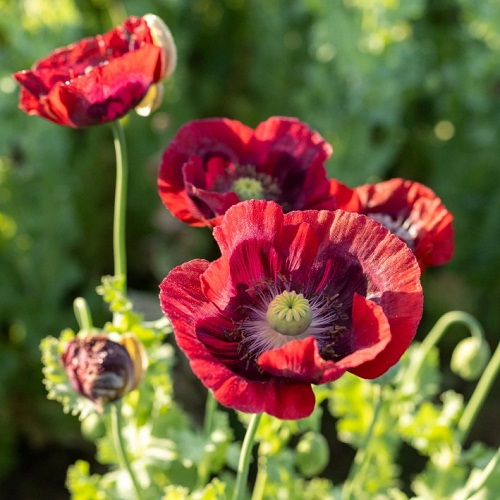
The English Maroon Poppy - often cataloged under heirloom varieties of Papaver somniferum (the breadseed or opiium poppy)—is a striking, deeply dramatic annual. It is highly prized by botanical curators, cottage gardeners, and floral designers for its moody, archival aesthetic and architectural presence.
Unlike the vibrant scarlet of the classic Flanders field poppy (Papaver rhoeas), the English Maroon belongs to the glaucous-leaved somniferum species. It is distinguished by its rich, velvety, wine-dark petals that hover somewhere between a deep burgundy and a bruised plum, frequently accented by dark, ink-colored basal spots at the center of the bloom.
The lineage of these deep maroon and purple-black poppies is deeply intertwined with the history of the English Cottage Garden. During the 19th and early 20th centuries, British horticulturists selectively bred Papaver somniferum away from its wild, pale-lavender origins, leaning heavily into double-petaled "paeoniiflorum" types (peony-flowered) and dark, somber hues. The English Maroon poppy is an open-pollinated heirloom that self-sows prolifically.
Growth Habit: It rises on sturdy, erect, silver-blue (glaucous) stems that contrast sharply with the dark blooms.
Foliage: The leaves are cabbage-like, deeply lobed, and clasp the stem, carrying a distinctive chalky, matte-green hue.
Height: Typically reaches 3 to 4 feet (90–120 cm) at maturity, making it an excellent mid-to-back border anchor.
The Seed Pod: Once the fleeting petals drop, they leave behind large, crown-topped, urn-shaped seed capsules. These pods retain the silvery-blue patina and are highly sought after for both fresh and dried floral arrangements.
In historical garden literature, these dark maroon variants were often kept as heirloom strains passed down between gardeners, celebrated for bringing an air of romance and gravity to traditional borders alongside delphiniums, foxgloves, and old garden roses.
Cultivation & Germination
Like most members of its family, the English Maroon poppy is a cool-season annual that thrives in well-drained, lean-to-average soil. It resents root disturbance and must be direct-sown , as it develops a deep, delicate taproot early on.
The Sowing Process
Timing: Direct sow outdoors in autumn or spring, just as the ground thaws.
Light Requirement: The seeds are minuscule and photoblastic, meaning they require light to germinate. Broadcast them over a cleanly prepared bed of fine, bare soil and press them lightly into the surface. Do not bury them.
Thinning: Once the silvery seedlings reach about 2 inches high, thin them ruthlessly to 8 to 12 inches apart . Crowded poppies will stunt, bolt prematurely, and produce vastly inferior blooms.
Growth & Maintenance
Sunlight: Absolute full sun is required to develop the rich, dark pigments in the petals and the sturdy cell structure of the stems.
Moisture: Keep the soil consistently moist during the early vegetative stage. Once established, they are remarkably drought-tolerant.
Fertility: Avoid heavy nitrogen fertilizers. Over-fertilizing leads to lush, weak, floppy foliage and heavy heads that fall over in a light breeze.
Seed Harvesting & Reseeding
The English Maroon poppy is an open-pollinated heirloom that self-sows prolifically. If you wish to collect the seed, leave the pods on the plant until they turn a brittle, ash-brown color and the tiny vents just beneath the stigmatic disc (the "crown") snap open. You can then tip the pods upside down into paper bags to collect thousands of slate-blue breadseeds for the next season's curation.
Copyright 2017–2026 Heirloomsnhybrids. All Rights Reserved.