Mikado California Poppy Seeds

Mikado California Poppy Seeds — Heirloom Crimson & Gold Bi-Color
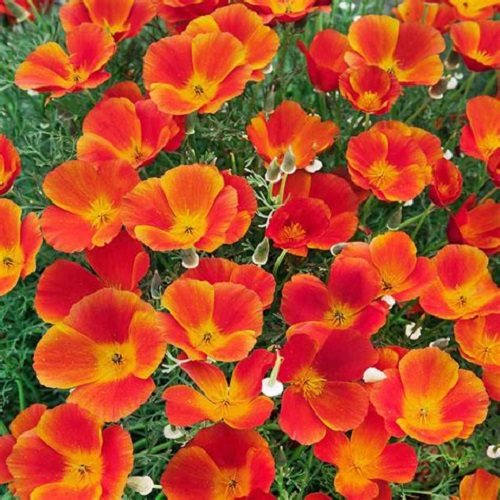
Ignite your garden borders with the breathtaking, high-contrast intensity of Mikado California Poppy Seeds, a timeless heirloom variety of Eschscholzia californica. Truly a standout in old-world botanical ledgers, Mikado is famous for its striking dual-toned appearance: the outer side of each silky petal is a rich, saturated crimson-scarlet, which opens up to reveal a brilliant, glowing orange-gold interior. This dramatic color combination lends an almost glowing effect to any sun-baked landscape.
Product Features
- Dramatic Crimson-Scarlet & Gold Bi-Color — Striking contrasting petals feature rich red on the reverse side and burning orange inside.
- Satin-Texture Bowl Blooms — Classic single cup-shaped blossoms catch the afternoon sun with a luminous, reflective sheen.
- Finely Cut Blue-Green Foliage — Delicate, lacy, silver-tinged leaf mounds grow to 10–14 inches tall, creating an elegant backdrop for the fiery blooms.
- Continuous Cool-Season Flush — Produces a steady succession of dramatic flowers from late spring through summer if consistently deadheaded.
- Rugged and High-Yielding — Highly efficient in poor, gravelly, unamended native soils; requires minimal watering once established.
Growing Information
Mikado California poppies establish rapidly from seed and demand very little attention once down:
- Sunlight: Absolute full, blazing sun exposure
- Soil: Lean, sandy, gravelly, or fast-draining unimproved earth
- Water: Low requirement; exceptionally drought-tolerant once roots run deep
- Planting: Direct surface-sow in early spring or late fall—press lightly into the bed but do not bury, as seeds need light to break dormancy
- Germination: 10–14 days when kept exposed to outdoor air and cool light cycles
Because they form a sensitive, early taproot that hates being shifted, direct-sowing exactly where they are intended to bloom permanently is essential for thick stands.
Ideal For
- High-contrast cottage garden spaces and low-water borders
- Naturalized wildflower meadows and sweeps
- Rock gardens, gravel pathways, and sun-baked banks
- Bee and pollinator sanctuaries (highly attractive to native bumblebees)
- Reliable autumn self-sowing cycles
Why Gardeners Love This Variety
The Mikado variety offers a **perfect fusion of wild, unbothered hardiness and arresting, dramatic color contrast**. They ask for practically nothing in terms of moisture or rich fertilizers, yet reward the visual curator with an unforgettable crimson-and-gold display that stands out vividly in any collection.
To germinate Mikado California Poppy seeds, surface sow them directly onto well-drained, raked soil during early spring or late autumn. Firm them gently into the ground to ensure soil contact, but do not cover them with topsoil or compost. Mikado poppy seeds require ambient light to break dormancy and sprout, which takes about 10 to 14 days under typical cool weather conditions.
The intense bi-color appearance of Mikado is a stable heirloom genetic trait. The outer petal tissues develop concentrated crimson-red pigments, while the inner surfaces produce brilliant orange-gold tones. To maximize this contrast, grow them in full sun and lean, unfertilized soil; overly rich soils can muddy the color profile or cause fewer blooms.
No. While Mikado poppies self-sow reliably by popping open their seed pods in late summer, they have a light, feathery habit and non-invasive root systems. They easily mingle into existing cottage gardens or gravel paths without choking out robust neighboring perennials, and any unwanted seedlings can be easily thinned out by hand in early spring.
Very sparingly. Once Mikado poppies develop their deep taproots, they are highly drought-tolerant and thrive on natural rainfall alone in most regions. Only water them during prolonged, extreme summer droughts, as overwatering or allowing water to pool will induce root rot and decline.